Sunday, October 25, 2015


Unit 4
Solar Energy


Solar energy is the cleanest and most plentiful renewable energy source. Solar energy comes from the sun and can be used for many things, including generating electricity, light, heating and cooling homes, and heating water. It is a flexible energy technology that can be constructed as a distributed generation, like at people’s homes, or a central-station, utility-scale solar power plant. These are like traditional power plants (besides their generation methods) that most of the time have storage capabilities to store the energy after the sun sets.

Solar energy can be captured in four different ways: photovoltaics (A.K.A. solar energy), solar heating and cooling, concentration solar power, and passive solar. Active solar systems use mechanical and electrical devices to convert the sun’s light and heat to another form of energy to use. Photovoltaics, solar heating and cooling, and concentration power are all active solar systems. The most commonly used method is solar panels, normally located on rooftops to capture the sunlight. Passive solar is a method that involves a building being capable of collecting, storing, and distributing the heat energy from sunlight to maintain a comfortable temperature inside without using moving parts or 
electronics.
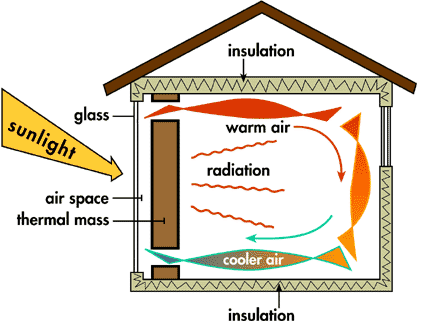
Passive Solar System

Active Solar System


Pros:                                                        Cons:                                       

Renewable                                             Sunlight Isn't Available 24/7
Abundant                                                Expensive Installation
Environmentally Friendly                        Expensive Technology
Available                                                 Expensive Raw Materials
Reduces Electricity Costs                       Production Creates Pollution
Tax Credit


Solar energy is a very clean, unlimited source of energy that is still being developed and researched every day. It is readily available and environmentally friendly except for the waste that is created in the production process. Production is also very expensive because of the raw materials, and installation is just as pricey. The investment is normally worth it though because of the 30% tax break and reduced electricity costs. Over time, home solar energy systems normally pay themselves off while creating clean, renewable energy.  Besides price being an issue, the sun itself can cause some problems.  Sometimes there can be a lack of sunlight, therefore causing the effectiveness of solar energy to go down.  In solar power plants, scientists are suggesting having back up sources like wind turbines in combination with solar panels.  That way if there is a lack of sunlight, maybe the wind turbines can take over and vise-versa.    


Thursday, October 8, 2015

Unit 3
Animals 'Making a Comeback'


     Over the past couple of decades, Europe has been pursuing their goal of restoring animal populations.  Since the late 1950's and early '60's, many European countries have been working hard to save many of their species of animals, mostly mammals and birds.  They have had great success with the program over the years, and recently a report was released called 'Wildlife Comeback in Europe.'  It's the first in-depth report that documents Europe's species recovery.
     Animal population decline is a recurring problem around the world.  There are many factors including over-exploitation, poaching, and mainly habitat loss that contribute to the problem. Europe, on the other hand, has actually seen an increase in their animal populations because of their valiant efforts to restore them.
     Tighter hunting regulations and habitat protection are at the front line of their defense, and have proven to be key in their success.  The Barnacle Goose is a good example of this.  Since 1950, the goose population in Russia has increased from 10,000 individuals to 908,000 in 2009.  Human migration from rural areas to the cities have also helped animals thrive by giving them more space to live.


     Besides the geese, most bird populations remained the same, but certain mammal populations have seen amazing growth, the average being a 30% increase in mammals.  In the early 20th century, the bison went extinct in the wild, but now there are nearly 2,759 individuals living free in Europe today.  That's a 3000% increase since 1950.  The European beaver has also seen a tremendous recovery with a 14,000% increase since 1960.  The beaver population went from 1,200 to 337, 500, making up 33% of the worlds' population.  White-tailed sea eagles, Red kites, Northern chamois, bears, and grey wolves, just to name a few, have all seen an increase in population since the fifties.  

     Increasing animal populations is fantastic, but it has caused some headaches for farmers.  The geese and birds are starting to cause conflict, and many people, especially farmers, are concerned about the increase in the wolf population.  Compensation and subsidies plans are currently in place in some European countries to try and help out farmers without killing the animals.
The comeback project has greatly helped Europe increase their biodiversity and even save animals from extinction!

Resrouces:
http://www.bbc.com/news/science-environment-24230765
http://www.theecologist.org/News/news_analysis/2131711/wildlife_comeback_in_europe.html


Sunday, September 27, 2015

      
Unit 2 
Globalization


Today, more than 2% of the global population lives in a different country than they were born in.  Two percent doesn’t sound like a lot, but when that percent is turned into an actual number, it becomes much more significant.  That two percent represents more than 200 million people who are living in their non-native country.  That’s not even including tourists and short term visitors, just foreign-born people.  This means that there are lots of people exploring the world, educating themselves, experiencing other cultures, maybe bettering their lives.  Globalization has made travel possible and easy to almost everyone on the globe, giving them access to the world around them.  It has made communication and business multiple times easier and more efficient, but it has also brought along some nasty friends. 

The cross-continental travel of people has provided a perfect opportunity for diseases to reach all across the world.  Commodities, products, and food can all transport diseases along their travel routes as well.   With the increasing population and number of tourists and refugees diseases are spreading rapidly.  Countries are becoming exposed to diseases that they never even knew existed before they all of a sudden have an outbreak on their hands.  These diseases can include anything from the common cold to AIDS or Ebola. 

Because travel time has become so short, people may not know that they are infected when they leave their home or even when they reach their destination.  The incubation period of most diseases are now longer than the time it takes to travel the whole way around the world.  This makes diseases sly and invisible and very hard to detect until they emerge, which is often too late. 

Disease control, like vaccinations, has helped developed countries prevent widespread disease outbreaks, but disease control plans are not installed in every country around the world.  This limits the ability of disease control to actually work to its full extent.  Diseases can also be spread through animals and products as well as people, making them even more difficult to control.  Tuberculosis is a disease that America, Australia, and many European countries have successfully controlled and almost gotten rid of.  Many undeveloped countries though still experience many deaths because of it.  In 1993, tuberculosis was considered a global emergency by the World Health Organization.  Many migrant-receiving nations have seen a larger number of tuberculosis cases in the immigration population than in the native population, because of the immigrants from countries where tuberculosis remains a public health problem.  Developed countries are seeing many more cases of harmful diseases like malaria and HIV/AIDS due to migrants as well.  

Sources: 
http://cid.oxfordjournals.org/content/38/12/1742.full#sec-1
http://www.nap.edu/read/11588/chapter/3#24


Sunday, August 30, 2015


Unit 1
Immigration


     In 2014, there were 11.3 million unauthorized immigrants living in the United States, accounting for 3.5% of the U.S. population.  To many, this number is appalling, and they would like a change to occur in the U.S. immigration policy.  Although the number may seem high, these unauthorized immigrants make up 5.1% of the U.S. work force.  Again, this could be considered a good or a bad thing depending on who is asked.  Most employers don’t mind it because illegal immigrants are willing to work for less, most times doing jobs that are unpleasant, and labor intensive.  Others claim that they are stealing jobs that belong to Americans.  Another question to be asked though is: are most Americans actually willing to do the jobs that the immigrants are doing, like working in hot fields all day for less than minimum wage? 


These questions and many others are being vigorously debated upon between the candidates for the 2016 presidential race.  It is especially a hot topic on the republican side.  In November 2014, President Obama announced new executive actions to stop the deportation of millions of illegal immigrants.  Republican front runner, Donald Trump, has a completely different plan.  His proposed plan includes the deportation of all undocumented immigrants living in the U.S., and building a wall along the U.S.-Mexican border.  Deportation has been somewhat favored in the Republican Party, but they also realize that this would be a very unrealistic reality.  Many people believe that there should be a change to the 14th Amendment of the Constitution and ban birthright citizenship.  This notion, and the notion of building a wall are more highly favored by most Americans than complete deportation.  Another solution being debated is that of legal status.  Changing millions of peoples’ status from illegal to legal would obviously get rid of the millions of illegal immigrants in the U.S., but Republicans are also worried that that would imply that illegal behavior is encouraged. 


Another way to combat illegal immigration that has come up is to eliminate the pull factor.  Many Mexicans flee to America because it’s close, but also because most of the time the laws aren’t enforced, and it’s easy for them to stay.  They can use a fake social security number to obtain a job, they start a life, and after a while it’s no longer relevant that they are an illegal immigrant. Instead of making a bunch of changes to already existing policies, why don’t we just enforce them?  The use of electronic detection systems to stop the use of fraudulent social security numbers has been proven successful and could be used more often.  If immigrants know that they could be caught and there would actually be consequences, they might not be as eager to come.

      However, regardless of immigrants’ legal status, it’s undeniable that they play a big role in America’s success; socially, economically, and culturally.  There may not be an obvious right or wrong way to deal with the current immigration situation in the United States, but we will definitely be seeing some changes in the near future. 


Sources:
http://www.pewresearch.org/fact-tank/2015/07/24/5-facts-about-illegal-immigration-in-the-u-s/
http://www.pewresearch.org/fact-tank/2015/08/24/what-americans-want-to-do-about-illegal-immigration/
http://www.csmonitor.com/Commentary/One-Minute-Debate-3-Views/2012/0924/3-views-on-how-US-should-combat-illegal-immigration/Another-way-Enforce-the-law-provide-amnesty-at-a-price-and-be-choosier-about-who-gets-in